April 25, 2012

Sierra County Courthouse - a new view

The building was icon in its time. Even today, as the pull of gravity reduces the historic former Sierra County Courthouse to rubble, the building is still something to see. Here's a look at a view the likes of Oliver Lee and Jim Gilliland had for a spell.  They were tried and acquitted for killing the 8-year-old Henry Fountain.

As hammers nailed planks together, construction of a platform from which teenager girls Valentina Madrid and Alma Lyons would hang by the neck was underway on the courthouse lawn. They may have watched the workers build the device that would kill the condemned gals.

No doubt many other miscreants and those wrongly accused had this same view.

The jail and courthouse ruins are iconic today.  The jail is one of the 100 historic images on the New Mexico Centennial celebration's Get the Picture contest.  Will this historic ruin be completely lost, or might it be conserved for posterity and interpretation of New Mexico's rich judicial heritage?


April 1880 - A claim for Indian Depredations


Romolo Montoya of Monticello, New Mexico, documented in April 1880 that he lost cows, calves, oxen, and one mule, all told worth $775. Montoya lamented that he could have lost his life when Victorio and his followers were at "the height of their atrocities."

Warm Spring Apaches led by Victorio in 1879 - 80 and Nana in 1881, had area residents on edge and the U.S. Army on the move. The threat of loss of life or property was such that it prostrated the mining industry around Hillsboro in 1880, so said mining engineer, Frank Robinson, in a letter to his wife.

April 21, 2012

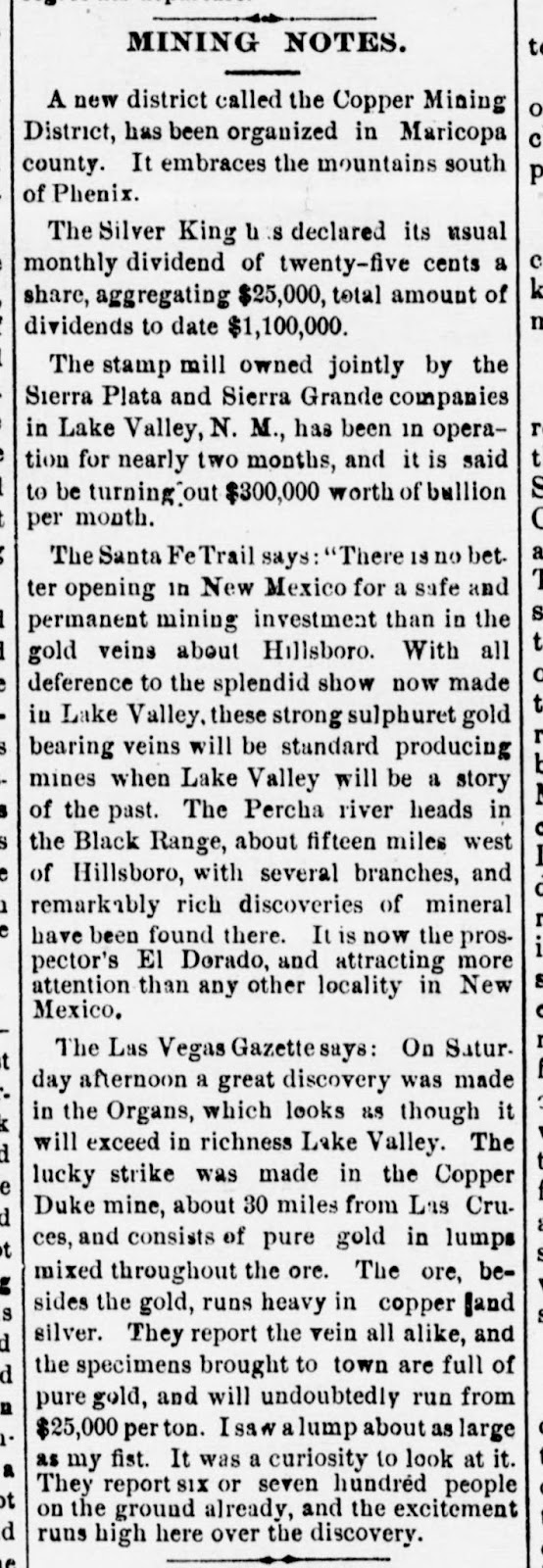
Tombstone Epitaph Dec. 2, 1882


This news clip from Tombstone documents the goings-on around Hillsboro.  Kingston yet unknown by name by this newspaper was getting attention by prospectors and speculators. Kingston had in fact had already been platted as a townsite three months earlier.

March 28, 2012

First Sierra County Assessor makes New York Times

If you own property in Sierra County, you recently received your Notice of Value stating what the county assessor reasons that your property is worth. From that, the county determines what you own in property tax.

Oliver Wendell Holmes said taxes are what we pay for a civilized society.  One of the men responsible for shaping a civilized society from the wilderness at the head of Percha Creek in the early 1880s was James Porter Parker, a Confederate veteran of the Civil War.

The portly Parker, who lies at rest in the Kingston cemetery was covered in a finely wrought New York Times column recently.  The Ronald Coddington story is part of the Disunion series covering the 150th anniversary of the war between the states. For our readers this is a story twice told -- Matti Nunn Harrison told it here a year ago. Parker, a civil engineer, surveyed the Kingston townsite in the autumn of 1882, and was elected as the first Sierra County Assessor in the spring of 1884.

It's great to see the NY Times write about Kingston and Hillsboro and use a historic photo, probably taken by George T. Miller. The original photo exists in the George T. Miller collection in the Black Range Museum. The photo of Parker is crisp and clear, as you would expect from a professional photographer.  The buffalo gourd flower in Parker's vest pocket looks freshly picked. Miller apparently took several photos of Parker that same day.

You can read the New York Times story, by clicking here.

You can see other Parker images and read what Matti Nunn Harrison published last year by clicking here.

Matti Nunn Harrison and twin sister Patti Nunn co-authored a local history that features Parker and others notable men and women in the book Around Hillsboro.  Book royalties go to the Hillsboro Historical Society.  --Craig Springer

NOTE: Comments are open to all, below.


James Porter Parker lies in an unmarked grave, perhaps this one, in the Kingston cemetery. Few prettier places can be found for earthly remains to spend eternity. Photo Patti Nunn.

March 11, 2012

A Poisoning at Hillsboro

By Robert J. Tórrez
Rough on Rats killed Manuel Madrid
One of the most fascinating and tragic incidents of crime and punishment in New Mexico's history unfolded the morning of March 30, 1907 as news of the death of Manuel Madrid spread through the community of Hillsboro. The surprising news of Madrid’s untimely death must have quickly turned to shock when Dr. Frank Given, a Hillsboro physician called to Madrid’s bedside by his brother the morning he died, reported to Sierra County District Attorney H. A. Wolford that the dying man had exhibited obvious signs of arsenic poisoning. A coroner’s jury convened by Wolford quickly implicated Valentina Madrid, the sixteen year old widow, and Alma Lyons, her seventeen year old childhood friend. Both girls quickly confessed they had poisoned Madrid, but also implicated Francisco Baca as the mastermind behind the crime.


Albuquerque Citizen. LOC.
News of the arrests caused a sensation throughout New Mexico. The alleged love affair between Mrs. Madrid and Baca, the girl's age, and the heinous nature of the crime, sparked a storm of public comment and controversy. The trio was brought before District Court Judge Frank Parker at the May 1907 term of Sierra County District Court on charges of first degree murder. Elfego Baca, the famous former lawman from Socorro was appointed special prosecutor to handle the case for the territory. The three entered pleas of not guilty but Judge Parker separated Francisco Baca's case from that of the girls and ordered his trial held over to the next term of court. Baca was transferred to the territorial penitentiary in Santa Fe for “safekeeping.”

Tragically, the files of the girls’ and Baca’s trials have disappeared from the district court records held at the New Mexico State Records Center and Archives in Santa Fe, so developments and testimony from the trails has to be pieced together from newspaper reports and correspondence of the time. These documents and stories in Hillsboro’s own Sierra County Advocate show that Manuel Madrid and Valentina had not been married long when Francisco Baca fell "desperately in love" with Valentina.  Both girls testified Baca wanted to get rid of Madrid so he could marry Valentina and laid out a plan to poison Madrid. The girls initially resisted the idea, but Baca allegedly threatened them if they did not cooperate. Caught in a quandary, Valentina and Alma decided they had no alternative but to proceed with the plan, and with fifty cents Baca gave them, Alma purchased an arsenic poison called “Rough on Rats” which Valentina mixed into her husband's coffee every morning. Within a week, Madrid was dead.

Both girls insisted that Baca had urged them on and promised he would stand by them even at the risk of his own neck. Baca's resolve, however, did not last long. Throughout the girl's trial, he maintained his silence, and when his own trial was held in May 1908, he vehemently denied the girls' testimony. Baca's 1908 trial ended in a hung jury, and when he was finally re-tried in 1910, he was acquitted. A newspaper reported that although the jury felt he was an accomplice, they did not feel there was enough evidence for a conviction of first degree murder. 

Meanwhile, the girl's own trial concluded the evening of May 9, 1907. It took the jury less than an hour to return a verdict of guilty in the first degree. The following morning, both girls stood before Judge Parker to hear him impose the only sentence allowed by law - Valentina and Alma were to hang together on June 7, 1907. 

Teenage convicted murderers Alma Lyons (l) and Valentina Madrid were hours away from hanging from a rope outside the Sierra County Courthouse in Hillsboro in 1907. Dept of Corrections, Penitentiary of New Mexico, New Mexico State Records Center and Archives.

Albuquerque Citizen, June 4, 1907. LOC.
The sentences drew an outpouring of sympathy for the girls, as dozens of letters and petitions poured into Acting Governor James W. Raynolds' office at Santa Fe. Many were sympathetic and urged Raynolds to exercise his privilege of executive clemency and commute their death sentences to life imprisonment. Others insisted that justice demanded the sentence of the court should be carried out. Finally, reasoning that their execution would eliminate the territory's principal witnesses against Baca, Raynolds issued the commutation on June 4, three days before the scheduled executions. On June 7, 1907, the day they had been scheduled to hang, Valentina and Alma were transferred to the penitentiary in Santa Fe to begin serving their life terms. When Baca ended up being acquitted, the girls alone had to suffer any penalty for the murder of Manuel Madrid. 

Controversy, however, continued to swirl around the girls. In prison, Alma was assigned to do domestic work in Warden John B. McManus' quarters. While there, she developed an intimate relationship with a prison trustee, and soon found herself pregnant. When the situation became public, it took some quick action by prison officials to avoid a major scandal for the administration of Governor William McDonald. Slowly, however, public indignation died down, and early in 1914 Alma was admitted to St. Vincent's Hospital, where she delivered an apparently healthy boy who was adopted by a local family. Both girls were pardoned by Governor Octaviano Larrazolo in 1920 on the condition they not leave New Mexico, stay out of Sierra County and find “honorable employment.” The exact date Valentina and Alma exited the state penitentiary is unclear but they presumably walked out of the prison gates into a life of freedom quite different from the naïve young girls that entered those same gates thirteen years earlier.

You can read other news of the day on the Manuel Madrid murder and the tribulations of these two young women on this Library of Congress web site, Chronicling America. 
Robert J. Tórrez is the former State Historian of New Mexico. He is the author of The Myth of the Hanging Tree: Stories of Crime and Punishment in Territorial New Mexico.


Sadie Orchard Poisoned?

As the murder of Manuel Madrid by rat poising had quieted in late 1907, another fixture in Hillsboro, former prostitute and hotel owner Sadie Orchard, claimed that she had been poisoned. Mrs. H. Kubale was arrested, but later released we presume for lack of evidence of a crime. --Craig Springer

Albuquerque Citizen, November 22, 1907. LOC

An Unmarked Grave in Hillsboro, New Mexico: A lesser know Kimball Story

By Mark B. Thompson III

Richard Kimball is one of those early “immigrants” beloved by genealogists—not such an early arrival so as to make the “elite” but early enough to be interesting; not famous but with enough history and descendants to make it worth the effort to chronicle the Kimball family. For example, the 1287 page “History of the Kimball Family In America” was first published in Boston in 1897. With the recent genealogy boom and the growth of the internet, you will find one online genealogy tracing the family back to a Thomas Kimball, spelling of the surname disputed, born in Suffolk in 1370. Moving forward, one of his descendants, Heber C. Kimball, was Brigham Young’s “right hand man.” Heber Kimball is buried under an attractive monument in a downtown Salt Lake City cemetery. The resting place in Hillsboro, New Mexico for Heber’s second cousin once removed is not so impressive. 
Kimball cousins: Ninette Stocker Miller (l) with a lady believed to be her mother, Tamezin Kimball Stocker Dodge, on the east porch of the Miller home in Hillsboro, NM ca. 1905. George Miller Collection, Black Range Museum.


When Richard Kimball and his family sailed from Ipswich in Suffolk on The Elizabeth in April of 1634, England was already feeling the tension which would lead to civil war and regicide.  By requiring adults leaving England to sign an Oath of Allegiance to the crown and acknowledgment of the Supremacy of the Church of England, today’s genealogists were provided with a public record documenting the departure.  The 1897 history does get to the generation of Heber Kimball, and his second cousin, Russell Freeman Kimball, both born early in the 19th Century. They were a part of that generation which grew up feeling the tug of the American West, and while that makes for interesting stories, it also makes more detective work. Heber Kimball first went from his home in Vermont to New York.  Russell Kimball left his New Hampshire home for Illinois. Heber’s journey to Salt Lake City is well documented; Russell’s story, and that of his daughter, Tamezin, has not, for obvious reasons, received much attention.

Heber Kimball's final resting place, Salt Lake City, UT.
The Kimball family history only followed Russell Freeman Kimball through his marriage to Eliza Ann Austin in Elgin, Illinois in 1839. Land records show he owned property in rural Kane County, west of Elgin, in 1843. (Just in case you were wondering, the Illinois town where Joseph Smith met his death is a few counties to the southwest of Kane County and we have no evidence that Russell knew his second cousin, Heber.) I will try not to belabor the “detective story” but, again, genealogist will recognize the effort to “corroborate” a family story. Following the peripatetic Russell Kimball, both geographically and in the public record, raised as many questions as answers. 
The 1850 federal census for Brooklyn, McHenry County, Illinois, north of Kane County, includes a “Russel Kimble,” birthplace New Hampshire and occupation “Gold Seeker,” married to Eliza, with a child born in Illinois about 1842, the presumed birth year of daughter Tamezin. But the census did not have a full name for that child, only a “T” and, even worse, it indicated the child was a male. (Name experts believe that the name Tamezin, with several possible spellings, was a female version of Thomas.) It turns out that Eliza gave him his occupation title, perhaps with no lack of sarcasm, and a Russell F. Kimball, birthplace New Hampshire, occupation “carpenter,” is also enumerated in 1850 in a “boarding house” in Coloma, El Dorado County, California. Gold Seeker indeed! By the time of the 1860 census, Russell and Eliza had moved on to Goodhue County, Minnesota, southeast of St. Paul. They are listed with four children, but no “T” or Tamezin. Eliza died before the 1865 Minnesota census, and Russell would eventually move with son Artemus to Denver in Rock County, Minnesota, in the southwest part of the state.
This dapper fellow is believed to by H.D. Stocker, lawyer, mine owner, and father of Ninette Stocker and Harriett Galles. This photo was taken on the Miller porch ca. 1895. George Miller Collection, Black Range Museum.
According to her application for a Veterans Widow’s pension, Tamezin had married Henry D. Stocker of McHenry County, Illinois in November of 1859 in Lake City, Minnesota, which probably indicates that she had moved with her parents to Minnesota in the late 1850s. We find Henry and Tamezin enumerated in June of 1860 in the federal census for McHenry, McHenry County, Illinois. She is indexed online as 18 year old “Tenason Sticker” born in Illinois but fortunately she and Henry “Sticker” were joined by a Sarah Kimball, probably a cousin, to give us confidence in concluding that it  was “our” Stockers. Their first child, Harriett (“Hattie”), was born in May of 1861 in McHenry. Henry joined the Illinois volunteers and was commissioned a First Lt. with the 16th Cavalry in May of 1863. He was wounded and then captured at the battle of Jonesville, Virginia in January of 1864. He eventually escaped and was mustered out in October of 1864.
Although Henry Stocker had started practicing law in McHenry before the war, the Stockers are found in the June 1865 Minnesota census in Lake City, Minnesota, again as “Sticker,” something like “Thomas” for Tamizen, but also with “Hattie.”  Their second daughter, Ninette (“Nettie”), who would become a fixture in Hillsboro, New Mexico, was born in Minnesota in 1866,  but, shortly thereafter, things apparently got “interesting” because Henry eventually left Tamezin, Harriett and Ninette and married the widow, Hepzibah “Heppie” (Jackson) Grant. The 1870 federal census shows Tamezin and Henry with separate households in Lake City, Minnesota.  Henry and Heppie’s household included both Hattie and a five year old Franklin Grant. The “Tamison” Stocker household also included a Hattie Stocker as well as Nettie Stocker and a Nellie Kimball. Tamezin had no evidence of a divorce from Henry, which turned out to be both bad news and good news. It meant she may have been a bigamist by virtue of a second marriage, but, as we shall see, she was still potentially eligible for a Civil War widow’s pension.  


Cupid's cavorting, 1891: The Miller's would come to Hillsboro two years later.
In about 1875, Tamezin married Wesley O. Dodge and in the 1880 census she is found with Wesley and 14 year old “Nettie” in Red Wing, Minnesota, which is just up the road from Lake City in Goodhue County. (By 1880, her father Russell Kimball and her brother Artemus had moved from Goodhue County to Rock County in southwestern Minnesota. I believe Russell Kimball died in the 1880s.) We know little about Wesley Dodge, but the census of 1880 lists his occupation as “bookkeeper.” The Dodges are enumerated in the June 1885 Minnesota census in Red Wing, along with 19 year old “Nettie.” On Friday, June 28, 1891, The St. Paul Daily Globe reported that the wedding of Ninette Stocker and George T. Miller had taken place on Wednesday at the home of W.O. Dodge and wife on Clinton Avenue in Minneapolis. Henry Stocker and (second) family had also moved to Minneapolis, probably about 1887, and they lived on Nicollet Ave. At least by the 1895 Minnesota census, “Hattie” along with husband Nicholas Galles, had a home on Harriet Ave. in Minneapolis.  All of these homes were in close proximity to each other in an area east of Lake Harriet in the south part of Minneapolis.


Geroge T. and Ninette Stocker Miller on the back porch of the Hillsboro home ca 1905. George Miller Collection, Black Range Museum.
Once again things get “interesting” for Tamezin (Kimball) (Stocker) Dodge. In the federal census of 1900 she is found in the Nicholas Galles household on Harriet Street in Minneapolis.  She indicates that she is married, and has been for 25 years, whereas Wesley is enumerated at a separate address in Minneapolis and indicates that he is “single.” Just before the June 1900 enumeration of the federal census, Henry Stocker has been laid to rest in the Hillside Cemetery in Minneapolis, having died on May 23, 1900, in Prescott, Arizona. Although the Minneapolis newspapers said he had spent the “past two winters” in Prescott, we know that in fact he was practicing law in Prescott, having apparently left his second wife, “Heppie,” in Minneapolis. Although obituaries for Stocker mention his son Henry Jr. and his son-in-law, Nicholas Galles, there is no mention of either of his wives, both of whom were then living in Minneapolis.  
In 1902, Nicholas and Harriett Galles moved to Las Cruces, New Mexico, leaving Minneapolis and ending whatever presence they still had in Hillsboro, New Mexico. Ninette and George T. Miller had followed the Galles to Hillsboro in the early 1890s, having built the “Miller House” now featured in Linda Harris’s “Houses in Time: A Tour Through New Mexico History.” Although we know she spent some time with daughter Harriett in Las Cruces, for example, having been confirmed in the Episcopal Church of St. James, Mesilla Park in 1916, apparently Tamezin would live out her life with daughter Ninette in Hillsboro. Those twenty something years in Hillsboro appear to be the most stable of her eighty plus years on this earth.
Death Certificate: Tamezin Kimball Stocker Dodge.
Tamezin would, however, suffer one more indignity resulting from her “checkered” marital experiences. In 1910 she began the process of an application for a pension as the widow of Civil War veteran, Henry D. Stocker. You can imagine the twists and turns this application process took over approximately 15 years. She had no documentary evidence of her marriage to Henry, having to rely on an affidavit of a friend in McHenry, Illinois that the friend “knew them as husband and wife.” As it turned out, there was no evidence of a divorce, so, but for her second marriage, she could claim that she was Stocker’s widow at his death in 1900. What about the marriage to Wesley Dodge? She indicated in one statement that he had walked out on her in 1891, even before Ninette’s marriage in Minneapolis. The government’s response:  but are you not still married to Dodge? She then was able to prove by the affidavit of the attending physician that Wesley Dodge had died in Minneapolis on June 24, 1923.  Hmm.  The government kept asking for more information, undoubtedly because these things did not tie together neatly. 


Final resting place: Tamezin Kimball Stocker Dodge lies in the Hillsboro Community Cemetery in an unmarked grave. Photo Patti Nunn
In 1926 she abandoned the quest for a pension.  Tamezin died on January 8, 1927, in Hillsboro.  The official death certificate indicates a burial in Hillsboro, but there is no physical evidence of such at the Hillsboro Community Cemetery.


January 6, 2012

Kingston in Myth and Memory

By Craig Springer
To see the old photos, you can tell that Kingston was a busy place for a time. But that time didn’t last.
Set on the east flank of the Black Range in western Sierra County, Kingston is today a relic of the distant past. On some maps, it’s a ghost town. But everyone living there is alive--engaged in business, creating art, active in retirement. It’s an old mining town at the head of the Middle Percha Creek. From a distance, the Black Range looks the part of a long purple armada. The 10,000-foot Hillsboro Peak stands like a silent sentinel above. Vision through the gray distant haze over steep folded mountainsides becomes clearer as you get closer. And so it is with the myth of Kingston being New Mexico’s largest territorial town.
Kingston had its start with the discovery of silver. In the early 1880s, prospectors from nearby Hillsboro, Lake Valley, and Georgetown worked under the continual threat of Apache depredations as they scratched dirt for signs of precious metal. Like most of the Black Range, the surface is more rock than soil. It’s the rock that drew attention; it was rich with silver ore. In October 1882, James Porter Parker, a civil engineer and former Confederate Lt. Colonel and General George Custer’s roommate at West Point platted a townsite. The portly fellow became Sierra County’s first Assessor two years later.
Kingston topped out at about 1,500 residents ca. 1893. Starr Peak and the Caballo Mountain are seen in the distance. The stone church stands in the right margin of the photo. Photo Black Range Museum
Kingston was to get bigger. A Methodist minister in January 1888 reported on the progress of a stone church to serve Kingston’s 1,000 residents. There was work to do: “If I could take the reader along the main street on our way to a school-house for evening service, he would see the typical mining town in all its wickedness.” The minister lamented the gambling, smoking, drinking and a woman singing in soprano at the back of a hall. 
The town grew bigger yet -- but only in myth. In travel guides, state tourism office promotions, and academic writings by professional historians, you will see a phrase repeated so often that a myth has turned to “memory,” that Kingston once exceeded 7,000 residents and was the largest town in New Mexico. It’s even on Forest Service signs. Seven thousand is about as big as Truth or Consequences is today. And it’s a bogus number, usually attended by an equally bogus count of the number of newspapers that kept shop in town: three.


One is led to think that three publications competed for readers and advertisers. Actually, 10 newspapers published in Kingston from 1883-1893, but all were very short-lived titles except the Weekly Shaft. From April 1885 to March 1886 during Kingston's supposed prime the town lacked a newspaper. The Mines of Kingston, a March 1883 prospectus on the then five-month-old town of Kingston, was published by the weekly Tribune. Editor and publisher Charles W. Greene would pull up stakes and move the newspaper to Deming by Kingston's first birthday.
Those prospects may had already changed by the time the Bureau publication hit the streets. The economic Panic of 1893 and with silver prices going south, Kingston was all but abandoned. 
How such a myth got started is a bit of a mystery. The earliest writing on an inflated town size, a purported 5,000 people, that I found was in Log of a Timber Cruiser, published 22 years after Kingston was abandoned. 


Then, in August 1936, WPA writer Clay Vaden interviewed Sadie Orchard in Hillsboro. Orchard told Vaden that Kingston thronged with 5,000 residents in 1886. You can read what Vaden documented from Orchard in the Library of Congress holdings.


That same year Sierra County pioneer, James McKenna published Black Range Tales and upped the Kingston population by 2,000. And so it’s become gospel since, that Kingston was New Mexico’s largest town. 


The entire population of Sierra County didn’t reach 7,000 until 1950, according to the U.S. Census Bureau.


Craig Springer and his wife Felicia own the historic George T. and Ninette Stocker Miller home in Hillsboro. He's a professional writer in Santa Fe County.

Judge Frank Wilson Parker: Frontier Lawyer, Political Warrior

By Mark Thompson
In May of 1885, thirty-six residents of the Hillsboro area in Sierra County petitioned the territorial governor and the adjutant general seeking the creation of a volunteer militia to fight an insurgency in their backyard, the threat of the Apaches led by Geronimo. The petition resulted in the establishment of Company G captained by one of the petitioners, Nicholas Galles. Among the petitioners receiving a noncommissioned officer position was a twenty-four year old lawyer from Michigan, F. W. Parker. Company G saw limited service, September 30 through October 7, 1885, and, unlike politicians who regularly touted their experience as "Indian fighter," Parker apparently downplayed the importance of the campaign. Frank Wilson Parker, however, went on to make his mark in New Mexico legal history, proving to be a courageous participant in the political wars.

F. W. Parker was born October 16, 1860, on a farm in Sturgis Township, St. Joseph County, located near Kalamazoo, Michigan and also bordering the State of Indiana on the south.  His grandfather, John Parker, and grandmother, Elizabeth (Leiser) Parker, were born in Pennsylvania but had moved to Michigan from New York shortly after the birth in 1829 of Frank’s father, James Wilson Parker. Frank’s mother was Maria Antoinette Thompson of Sturgis, Michigan who at age 15 was living in the John Parker household, indicating, perhaps, the early death of her parents. 

The biographical sketches, including remarks printed in the New Mexico Law Reports, indicate that Parker attended school in the town of Sturgis and at age eighteen entered the University of Michigan. One biographical sketch indicates that he took “a limited course in the ‘Academic Department,’” and another has him graduating from the “Ann Harbor” Law School. Although Parker is not mentioned in a compilation of graduates and ex-students of the University of Michigan Law School serving in the judiciary in the United States, the official school website includes Parker in the class of 1880.

The University of Michigan Law School, probably the premier public law school in the United States, was established in 1859, at a time when it was rare for lawyers to have any academic training in the law. In 1878, the only two requirements for admission to the Law Department were proof that the applicant had reached age eighteen and was of good moral character. Graduation with an LL.B. required only completion of the full two-year course and passing an “approved” examination, including a dissertation. I did not find the exact date for Parker’s completion of studies, or for his admission to the Michigan Bar, but in the federal census for July 1880, he is shown with the occupation “lawyer.”    

Possibly at the suggestion of a friend, in October of 1881, Parker moved from Michigan to Socorro, New Mexico. The next month, now 21 years of age, he was admitted to the Bar by the Second District Territorial Judge, Samuel C. Parks. With two years of academic study of the law and a year of practice in Michigan, Parker should have had no trouble gaining admission to the practice of law under the standard prevailing at the time. One fanciful biographical sketch says he was examined by a committee of the bar, but even if Judge Parks had some help in the process, Parker only needed to convince the judge that he knew enough law to be granted his license. In 1881, admission by one of the territorial judges was sufficient for all purposes. New Mexico did not limit the power of the individual judge and had no uniform standards for admission until 1909.
Sierra County Courthouse as seen from atop the George T. Miller home. Frank Parker practiced law here, and presided over the trial of Oliver Lee and Jim Gililland for the murder of 8-year-old Henry Fountain. Photo George T. Miller Collection Black Range Museum
Shortly after admission to the bar, Parker moved his practice to La Mesilla, and, with an intermediate stop in the emerging town of Kingston in 1882, by 1883 he had taken up residence in Hillsboro, where he practiced law for the next fourteen years. In addition to his brief stint in the territorial militia, he participated in Republican Party politics and he served a two-year term as Sierra County school superintendent, an elected position. By 1897, U.S. Presidents, in the absence of overriding political needs, were willing to appoint "local" lawyers to the territorial bench, and President McKinley picked Parker to succeed Judge Gideon Bantz on the Territorial Supreme Court and as judge for the Third District, with headquarters in Las Cruces.   

Territorial judges appointed by the President served as trial judges in their individual districts and as appellate judges sitting as the territorial supreme court. Although they were “federal judges” in that they were appointed by the President and confirmed by the Senate, they did not have lifetime tenure, i.e. they were not “Article Three Judges” under the U.S. Constitution. With a four-year appointment prescribed by the act creating the territory, they were characterized as “legislative” judges. Obviously politics played a large part in their appointment and reappointment, and some historians claim that they served at the “will of the President.” I have argued elsewhere that the Congress intended that judges have more independence than territorial executive branch officers appointed by the President, and consequently could not be removed on a whim except during the existence of a separate federal law, the so-called “Tenure of Office Act.”

Even if they had some tenuous hold on their seat, the judges were products of the political system and "political" lawsuits, including criminal prosecutions, were probably more common than we would like to think. To have the confidence of the parties and lawyers and to be considered honest and fair was no small task for a trial judge.  Perhaps overlooked, at least by those of us far removed from the fray, was the need for the personal courage required to administer justice under the circumstances. Just two months after assuming the bench on January 10, 1898, Frank Parker would be tested by involvement in what certainly would be considered one of the most "political" criminal cases in New Mexico history.  

On February 1, 1896, the prominent lawyer and former Speaker of the House of Representatives, Albert J. Fountain, disappeared with his young son Henry somewhere between Lincoln and their home in La Mesilla and were presumed dead. Finally, in a long anticipated move, Sheriff Pat Garrett of Dona Ana County, on April 3, 1898, asked Judge Parker to issue arrest warrants for Oliver Lee, Jim Gililland and William McNew. Although the judge granted the application, it would be another thirteen months before he could get the case to trial. I have no intention of “retrying” the murder case, which would be something like “carrying History to Hillsboro,” but it would be interesting to see the case from the viewpoint of a new judge, something we are unfortunately prevented from doing in the absence of a memoir by a long retired judge.
Lawyer, and later Justice Frank W. Parker, walked through this east arch of the Sierra County Courthouse, this image taken in 2010. Photo Craig Springer
First, there is an apocryphal story that every new judge is warned that in a criminal case he should never sustain the prosecution objection to evidence tendered by the defense and, to the extent possible, always sustain the objections of the defense. The reason is simple—the judge does not want to give the defense grounds for overturning a conviction on appeal. Without even knowing Parker’s motivation, it is possible to answer the criticism that he acquiesced in all of the “demands” of the defense by just applying the apocryphal rule.

Secondly, the politics of the case was extreme. Even after Parker issued the warrants in April 1898, the political maneuvering continued apace, including the formation of Otero County to deprive Dona Ana County Sheriff Pat Garrett of jurisdiction. After the new county was created effective January 30, 1899, Oliver Lee surrendered in March 1899 to George Curry, a future governor and the newly appointed sheriff for Otero County. Parker was able to set the case for trial in May, after first granting a defense motion for a change of venue from Otero County to Hillsboro in Sierra County.

The fight on several levels, including in the legislature, was between Albert B. Fall of Las Cruces and Thomas B. Catron of Santa Fe, the men who would eventually be selected as the first U.S. Senators for the State of New Mexico. Fall represented Lee and Gililland, Catron was a special prosecutor aiding the district attorney, Richmond P. Barnes. It seems likely that Judge Parker knew most of what was “at stake” politically, but did he himself orchestrate the result?  Fall even accused him in closing arguments of being a part of the conspiracy to convict Oliver Lee, probably pure political theatre rather than a serious claim by the defense. At least the residents of Hillsboro and the spectators at the trial made it clear where they stood—upon the announcement of “not guilty,” “[t]he people cheered.”

Having been twice reappointed to the territorial bench, Parker in 1909 then presided over what many view as the sequel to the Lee/Gililland trial, the prosecution in Las Cruces of Wayne Brazel for the murder of Pat Garrett. Garrett had been killed in March of 1908 and Brazel had immediately "confessed" with a claim of self-defense to Dona Ana County Sheriff, Felipe Lucero. The case came on for trial on April 19, 1909, and was over with a “not guilty” verdict in one day. No cheering by the spectators this time, but several citizens found it necessary, in a letter to the Rio Grande Republican, to defend the result and Judge Parker, perhaps against a charge of local bias favoring the defendant: “The presiding judge of this court, while a resident of New Mexico, is an appointee of the president of the United States, is a federal judge and has held such position for several years.” Albert B. Fall had again served as defense counsel, with former district attorney Herbert B. Holt taking the defense lead at trial. The later public relations campaign, although including Governor Curry and several prominent citizens, appears to be clearly instigated by Fall.    

By defending Judge Parker, Fall may have sought to avoid the issue historians have considered more important, the quality of the prosecution. Unlike in the Lee/Gilliland case, the prosecution this time had no big name lawyers, although Attorney General James Hervey may have suggested that the A.G.’s office handle the case. Instead, the prosecution was conducted by twenty-seven year old Mark B. Thompson, admitted to the bar in January 1906 and appointed district attorney by Governor Hagerman in March of 1907.  But to claim youth and inexperience as an excuse for a prosecution conducted, according to some historians, with “appalling indifference and incompetence,” would be disingenuous. Governor Curry in his letter to A.B. Fall suggested that the Attorney General had said the evidence did not warrant conviction but that “the district attorney thought it best to let the case go before a jury . . . .” Not exactly a ringing endorsement, but probably the best the prosecutor was going to get. Thompson would eventually become Fall's personal attorney and work for Fall in the Teapot Dome Scandal.

The Las Cruces years were good to Judge Parker, including a second marriage, this time to Anna Davis of Iowa in 1904. The union  produced one child, Frank W. Jr., born in 1907. In 1910, he was a successful candidate for delegate from Dona Ana County to the Constitutional Convention, joining fellow Judge Clarence J. Roberts of Colfax County as one of the powerhouse lawyers at the convention. Parker, as chairman of the Judiciary Department Committee, is generally credited with achieving the agenda of the conservative, “railroad lawyers” in making sure that the first New Mexico Constitution had an elected judiciary. Parker then obtained the Republican nomination for one of the three Supreme Court positions and was elected to the initial court at the special election in 1911. Following the final act granting statehood, the signature of President Taft on January 6, 1912, Frank W. Parker began a twenty-year career on the New Mexico Supreme Court.

An appellate judge may be one step removed from the political cases, but Justice Parker could not avoid involvement in the fascinating political controversy between a district judge and an Albuquerque newspaper editor. Carl C. Magee as editor of the decidedly Republican Albuquerque Journal decided to take on the party establishment and in 1921 lost his control of the Journal but was able to continue his attacks as editor of the New Mexico State Tribune. Much of his ire was directed at the judiciary, especially Judge David Leahy of Las Vegas, but Judge Leahy saw an opening for revenge when Magee made a comparatively mild criticism of Chief Justice Frank Parker, suggesting that Parker had failed to see anything wrong in the way the clerk of the Supreme Court was handling court money. Judge Leahy charged Magee with criminal libel and of course obtained a guilty verdict from a Las Vegas jury.  That was followed by an attempt to disbar Magee’s attorney, former Supreme Court Justice Richard Hanna. Both of these cases resulted in Supreme Court action, first, affirming Governor Hinkle’s pardon of Magee and, second, resulting in a slap on the wrist for Hanna.    

Judge Leahy could not let go and in 1924 he convicted Magee of direct criminal contempt of court, i.e. contempt of Leahy himself. Magee was again pardoned by the governor, but the sheriff refused to release Magee resulting in a habeas corpus “original proceeding” in the Supreme Court. Having recused himself from sitting on the first two cases, Parker wrote the opinion in the habeas corpus action, holding that the governor’s constitutional pardon power extended to those guilty of direct criminal contempt. “Judges are human,” wrote Parker, and the governor’s pardon is “a reasonable check upon the exercise of a one-man power…which often must be exercised under the stress and sting of personal insult, sometimes depriving the judge of the ability to act wisely and judicially in such matters.”  

In what could be unprecedented, on January 11, 1928, the New Mexico Supreme Court paused to eulogize its still sitting Chief Justice on the thirtieth anniversary of his first appointment. Lawyer and State Senator, Herbert B. Holt, a long time friend, and once a court reporter for Parker, was recognized and no doubt "pleased the court" by his remarks. Judge Parker had many more years to contribute to New Mexico law and, upon his death, the court devoted even more space in the New Mexico Reports to honor him and his work on the court. Frank W. Parker died in Santa Fe on August 3, 1932, and was buried in the Fairview Cemetery on Cerrillos Road. Justice Parker was memorialized in the halls of the Supreme Court.

The Bureau of Public Health official certificate states that the cause of death was "cirrhosis of liver," but, as if anticipating the "objection of counsel," the physician added a question mark on next line! 

Mark Thompson, a former member of the New Mexico Bar, lives in Centennial Colorado.  He is the great grandson of Nicholas Galles and the grandson of Mark B. Thompson.


New Mexico Centennial

Happy 100th Birthday, New Mexico!

At 11:35 AM Mountain Time, January 6th, 1912, the portly President William Howard Taft signed Proclamation 1175 - Admitting New Mexico into the Union.

The 47th star was officially added to the United States flag, July 4, 1912.

Viva!


President William Howard Taft admitted New Mexico into the Union, Jan 6, 1912. White House